Structural Drying & Dehumidification in Woodstock, GA
Surface drying makes a room look finished. Structural drying makes the framing, subfloor and wall cavities actually dry. The drying team sets the equipment to the room and pulls it only when the readings say dry.
(888) 532-4616Get Woodstock structural drying started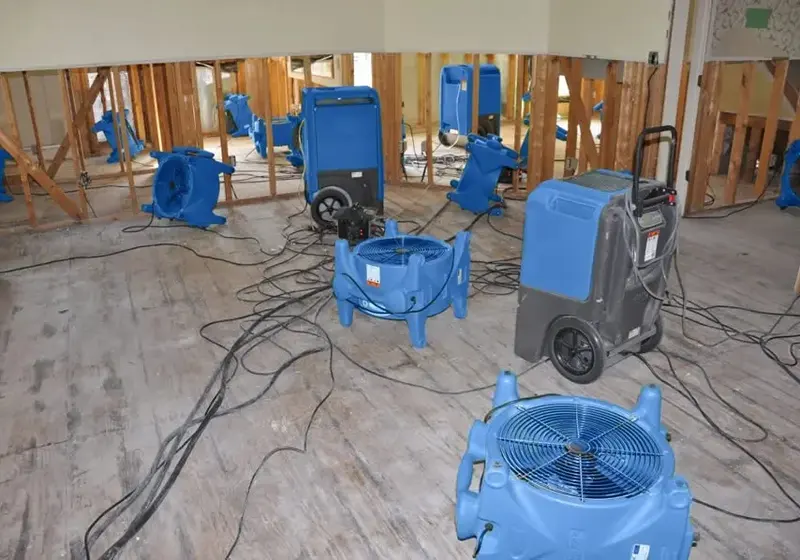
What to do first about structural drying in Woodstock
- 1Keep the heat or AC runningA conditioned house dries faster than one with the system off.
- 2Keep windows closedHumid outdoor air slows drying in a Georgia summer.
- 3Leave the equipment onTurning air movers or dehumidifiers off resets the drying clock.
- 4Call with questionsThe drying team adjusts equipment as readings change.
How structural drying is handled in Woodstock, GA
- 1
Map and classify
Moisture mapping and a Class 1 to 4 rating set the plan.
- 2
Place equipment
Air movers and LGR or desiccant dehumidifiers go in by room load.
- 3
Read daily
Readings on every wet material are logged each day.
- 4
Verify dry
Equipment comes out when materials meet the drying goal.
What does structural drying cost in Woodstock, GA?
In Woodstock, GA, structural drying typically runs $1,000 to $3,000 for a room or two and $3,000 to $8,000 or more for a full level or dense materials like hardwood and concrete. Extraction and removal are priced separately.
Room or two
- Air movers and one LGR unit
- Daily readings
- Three to five days typical
Full level
- Multiple dehumidifiers
- Cavity drying
- Drying log for the claim
Class 4 materials
- Desiccant dehumidification
- Hardwood or slab drying
- Longer monitoring
These are typical ranges, not a quote. The drivers are the water category, the square footage, the material class and how fast drying started. For a closer planning number, try the water damage cost calculator.
Structural drying is the part of a water loss nobody sees, and it is the part that decides whether the damage comes back. The drying team treats it as a measured process with a clear finish line, not a few fans left running for a weekend.
What structural drying actually dries
Water moves into the materials that hold a house up: the bottom plates of the walls, the studs behind the drywall, the subfloor under the carpet and the concrete slab under a basement floor. Those materials hold moisture long after the surface feels dry, and trapped moisture is what warps floors and feeds mold.
- Wall cavities behind drywall and baseboards
- Plywood and OSB subfloors under carpet and hardwood
- Concrete slabs in basements and garages
- Joists and decking between floors
How the drying plan is set
The tech who does the walkthrough maps moisture before any equipment goes down and sets the class of the loss, Class 1 through 4, which decides how much equipment each room needs. Air movers are placed to the room's evaporation load, LGR dehumidifiers pull the moisture back out of the air, and desiccant units handle dense Class 4 materials like hardwood and concrete. Readings are taken every day and logged.
Trade fact: the drying goal is set against a dry reference material in an unaffected part of the same house. Equipment comes out when the wet material reads within 2 to 4 points of that reference, not on a fixed day.
Drying in a north Georgia climate
Woodstock summers are humid, so the outside air rarely helps. The drying team keeps windows closed and lets the dehumidifiers control the air, and in winter keeps the house warm so the LGR units work efficiently. The EPA home moisture cleanup page explains why drying within 24 to 48 hours matters, and University of Georgia Cooperative Extension covers home humidity in Georgia. For the first step before drying, see water extraction, and try the drying-time estimator for a rough timeline.
Structural drying across Woodstock, GA
The Woodstock restoration crew handles structural drying in downtown Woodstock, Towne Lake, Eagle Watch, Bradshaw Farm and the Highway 92 and Sixes Road corridors, ZIP codes 30188 and 30189, with Holly Springs, Canton, Hickory Flat, Acworth, Kennesaw, Mountain Park, Roswell and Milton close by.
Structural Drying and Dehumidification questions in Woodstock, GA
What is the difference between structural and surface drying?
Surface drying dries what you can touch. Structural drying dries the studs, subfloor and slab behind and under it, verified with meters.
What is an LGR dehumidifier?
A low grain refrigerant dehumidifier pulls more moisture out of the air than a household unit, including air that is already fairly dry.
When are desiccant dehumidifiers used?
For dense Class 4 materials like hardwood, plaster and concrete, and in cold conditions where refrigerant units slow down.
Why can't the equipment come out after three days?
Equipment leaves when readings meet the drying goal. Some materials, especially hardwood and slabs, take longer.
Is the equipment noisy?
Air movers are loud, like a strong fan. Most homeowners stay in the house, and the drying team can adjust placement in bedrooms.
Will my electric bill go up?
A little. Air movers and dehumidifiers draw steady power for several days.
Related water damage services in Woodstock
Water damage in Woodstock right now?
The restoration team extracts standing water, dries the structure to the IICRC S500 standard and documents every step for your insurance claim.
(888) 532-4616Call for structural drying in WoodstockWoodstock Water Damage Restoration
Woodstock, GA · Cherokee County
Open 24 hours, 7 days a week